
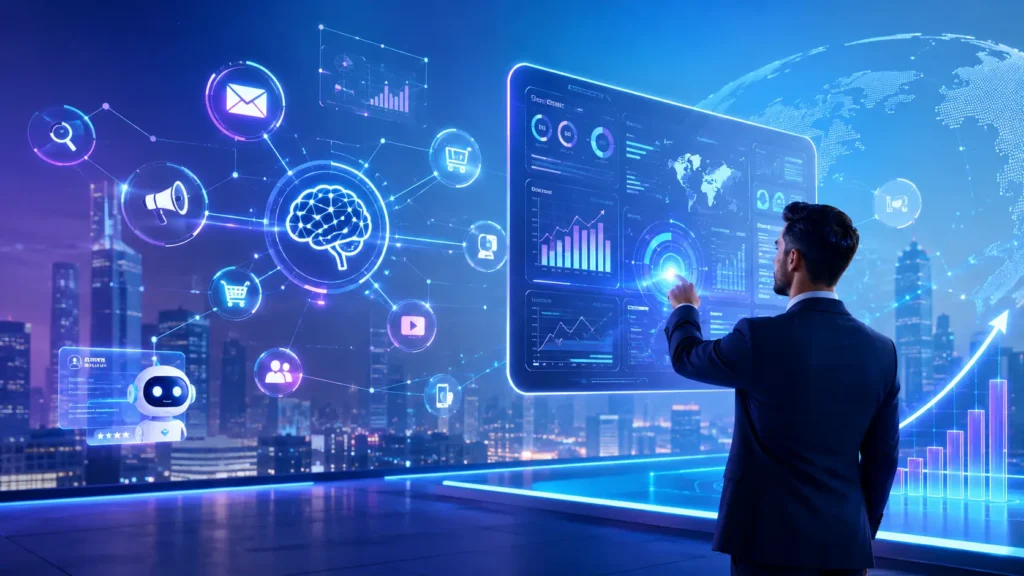
The connection between AI and marketing is no longer an area for testing. By 2026, Ai in digital marketing will be integrated into the processes of development-oriented companies, impacting how the brands communicate with their consumers. Where previously marketing professionals would spend hours manually dividing email lists and creating variations of their ads, nowadays machine-learning algorithms complete all those tasks within seconds and much more effectively than their human counterparts. This article explains why this is crucial information for every business owner and every digital marketer. Why? Because budgets are being redistributed, digital platforms change rapidly, and consumers demand more from brands. It is time for marketers to understand these changes.
The rise of AI has also increased the importance of partnering with a Digital Marketing Agency that uses advanced technologies to create data-driven strategies, optimize campaigns, and maximize ROI
Table of Contents
How AI Is Redefining Audience Segmentation
Traditional segmentation grouped customers by broad demographics, but AI in digital marketing now uses behavioral data, purchase intent, and real-time engagement insights to create highly targeted micro-segments that drive personalized customer experiences and improve campaign performance.
- Predictive models identify which users are most likely to convert before a campaign even launches
- Natural language processing (NLP) interprets customer sentiment from reviews, social comments, and support tickets
- Dynamic segments update automatically as user behavior changes, reducing manual list management
- AI in digital marketing uses machine learning to group audiences by psychographic traits, going beyond age and location for more precise targeting.
- Platforms like Google Ads and Meta Ads Manager now use AI audience expansion to find high-intent lookalikes beyond seed lists
AI-Powered Content Creation and Quality Control
AI in Digital Marketing enables the rapid creation of content drafts, but successful marketers use it to enhance creativity and efficiency, not replace strategic planning.
- LLMs create draft posts and descriptions as well as social media posts based on tone of voice
- AI analyzes popular posts and recommends changes to improve structure
- Automatic corrections for grammatical, readability, and branding errors eliminate editorial roadblocks
- Multimodal AI produces visuals, infographics, and scripts for videos just from a written outline
- Automated content repurposing processes transform a lengthy article into emails, social posts, and ad scripts
Search Engine Optimization in the Age of AI Search
Search habits have changed significantly with the rise of AI in digital marketing and AI-powered search engines like Google’s Search Generative Experience and Bing Copilot, which provide users with direct, conversational answers to their queries. As a result, SEO strategies must evolve by focusing on high-quality content, user intent, semantic search, and optimizing for AI-driven search experiences to maintain visibility and organic traffic.
- Prioritizing featured snippets and creating structured pieces of content is necessary to show up on AI answer pages.
- Entity-centric SEO links companies with meaningful topics and connects them to each other in the generative search engine result pages.
- Search engines (local and others) use semantic search algorithms to reward content databases or clusters of related content instead of focusing on specific keyword usage.
- AI tools will review web pages for technical SEO issues, crawling problems, and Core Web Vitals much more quickly than any form of manual review.
- AI in digital marketing has made voice search more important, as AI-powered systems pull answers from well-structured, high-quality web content.
Paid Advertising and AI-Driven Campaign Optimization
AI in Digital Marketing has revolutionized PPC and programmatic advertising by replacing manual management with automated, data-driven optimization for better campaign performance.
- Smart Bidding strategies on Google Ads utilize signals from real-time auctions (such as device, location, and query context) to bid automatically on each impression.
- Responsive Search Ads (RSAs) are able to test millions of headline and description variations and automatically serve up the best performing variations to potential customers after the ads go live.
- Using artificial intelligence (AI), programmatic display networks are able to make ad buys in less than a second and target users who are more likely to convert to customers.
- Performance Max campaigns enable advertisers to run ads in a number of ad locations including search, display, YouTube, and Gmail. Furthermore, these campaigns utilize AI to manage budgets across all of those ad placements.
- By detecting anomalies, advertisers are able to see any increases in traffic, decreases in conversions, or pacing issues such as running out of budget.
Customer Journey Mapping and Predictive Analytics
Getting the whole story from awareness to purchase once took weeks of data analysis. Today, AI in digital marketing has dramatically shortened this process through predictive analytics, enabling businesses to uncover customer insights, predict buying behavior, and make faster, data-driven marketing decisions.
- AI in digital marketing uses intelligent lead scoring to analyze customer behaviors and prioritize high-value prospects for sales.
- By means of machine learning algorithms, attribution models provide correct credit for all channels influencing the final conversion of a prospect
- Customer Lifetime Value is calculated before launching a marketing campaign to optimize the budget spending
- Customers who might get churned out of their engagement with your product will be detected automatically with a model predicting churn probability
- Using journey analytics tools, the actual journey of each customer can be mapped to identify bottlenecks for further CRO improvements
Conversational AI and Customer Engagement
AI in Digital Marketing has transformed chatbots and virtual assistants into advanced tools that go beyond customer support, helping businesses engage customers, generate leads, and improve user experiences.
- AI chat bots Like ChatGPT, Google Gemini on landing pages qualify prospects, address product queries, and schedule demos without any need for human intervention
- Conversational marketing software connects with CRM solutions to capture chat activity as contacts within the sales funnel
- Sentiment analysis tools analyze real-time chat data, alerting companies to route highly frustrated users to human agents
- WhatsApp and SMS-enabled AI assistants are becoming popular in markets where consumers primarily use messaging applications
- AI voice agents deal with inbound phone calls for making appointments and responding to basic customer queries
Social Media Strategy Enhanced by AI
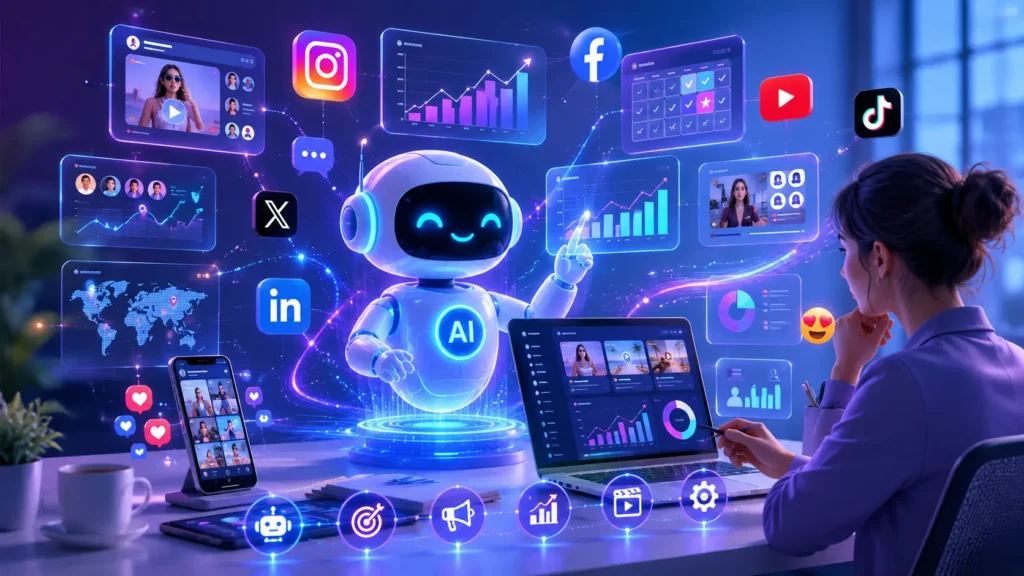
AI in Digital Marketing has transformed social media management from reactive posting to intelligent, data-driven strategies. By leveraging AI-powered analytics and automation, businesses can optimize content timing, personalize audience engagement, and improve campaign performance for better marketing results.
- AI-based analysis of past posts enables prediction of the best post format, best time to post, and captioning style
- Algorithms that recognize upcoming trends help brands stay ahead of the curve when it comes to posting about trending content
- Automation of competitors’ engagement rate and hashtag strategy analysis helps in tracking changes in ad creatives
- AI creation of short-form video script based on each platform’s algorithm improves efficiency in creative development
- Social media listening enabled by NLP allows brands to be aware of their mentions, avoid public relation issues, and create partnerships
Email Marketing Automation and AI Optimization
Email is the most ROI-efficient digital marketing channel, and AI in Digital Marketing has vastly improved its effectiveness.
- Predictive send-time optimization ensures that emails arrive at times when individual recipients are most likely to read them, rather than simply on a set schedule for broadcasting emails
- Subject lines created by AI systems test multiple variants simultaneously across subscriber groups
- Behavioral sequences trigger responses from actions such as abandoned carts, pageviews, or form submissions with highly context-specific messaging
- Email lists can be automatically cleaned to remove inactive subscribers and ensure they go through re-engagement funnels
- AI in digital marketing automates email sequence creation and testing, optimizing open rates, click-through rates, and conversions.
Data Privacy, Compliance, and Ethical AI Use
As AI In Digital Marketing technologies become increasingly advanced, the need for correct usage becomes greater. Regulatory and customer expectations necessitate good governance.
- The General Data Protection Regulation (GDPR), California Consumer Privacy Act (CCPA), and other laws mandate the explanation of how AI is processing people’s personal information.
- Companies are moving from third-party cookies to their first-party data strategy, thereby increasing the value of their owned data.
- AI bias audit determines if the targeting system discriminates against any protected groups of individuals.
- AI in digital marketing relies on consent management software to collect and manage user permissions, ensuring compliant and personalized marketing automation.
- Responsible AI usage, especially transparency when AI creates consumer facing content, is increasingly becoming a brand’s strength.
Conclusion
AI in digital marketing is not something to be thought of in one dimension. It represents an entirely new paradigm in the way companies think about audience analysis, content creation, campaign management, and measurement. By 2026, success in the industry will belong to organizations which know how to marry the human element of strategy and creativity with intelligent automation of tasks. Business owners should undertake an audit of their existing technology stack and find opportunities to integrate AI solutions into processes in order to eliminate any bottlenecks. Marketing specialists will need to learn more about predictive analysis, AI-generated copywriting, and the use of intelligent advertising platforms.
Frequently Asked Questions
Q1: What does AI in digital marketing actually mean? AI in digital marketing refers to the use of machine learning, natural language processing, predictive analytics, and generative AI tools to automate, personalize, and optimize marketing activities across channels like search, email, social media, and paid advertising.
Q2: How is AI changing SEO in 2026? AI is changing SEO by shifting focus from keyword density to semantic relevance, entity-based optimization, and structured content that AI search engines can extract and cite in generative answers. Content strategy must now account for how AI-powered search platforms like Google’s SGE interpret and present information.
Q3: Is AI replacing digital marketers? AI is not replacing digital marketers. It is shifting their role from manual execution to strategic oversight. Marketers who understand AI tools and can direct them effectively are significantly more productive than those working without them.
Q4: How can small businesses benefit from AI in digital marketing? Small businesses benefit most from AI-powered email automation, smart bidding in paid advertising, and AI writing tools that reduce content production costs. These tools lower the expertise barrier and allow smaller teams to execute campaigns that previously required larger resources.
Q5: What is generative AI’s role in content marketing? Generative AI accelerates content creation by producing drafts, suggesting structures, and repurposing existing assets across formats. It is most effective when guided by a clear brand strategy and editorial standards, rather than used as a fully autonomous publisher.
Q6: How does AI improve paid advertising performance? AI improves paid advertising by automating bid adjustments at the impression level, testing ad creative combinations at scale, identifying high-intent audience segments, and reallocating budget across channels in real time based on performance signals.