
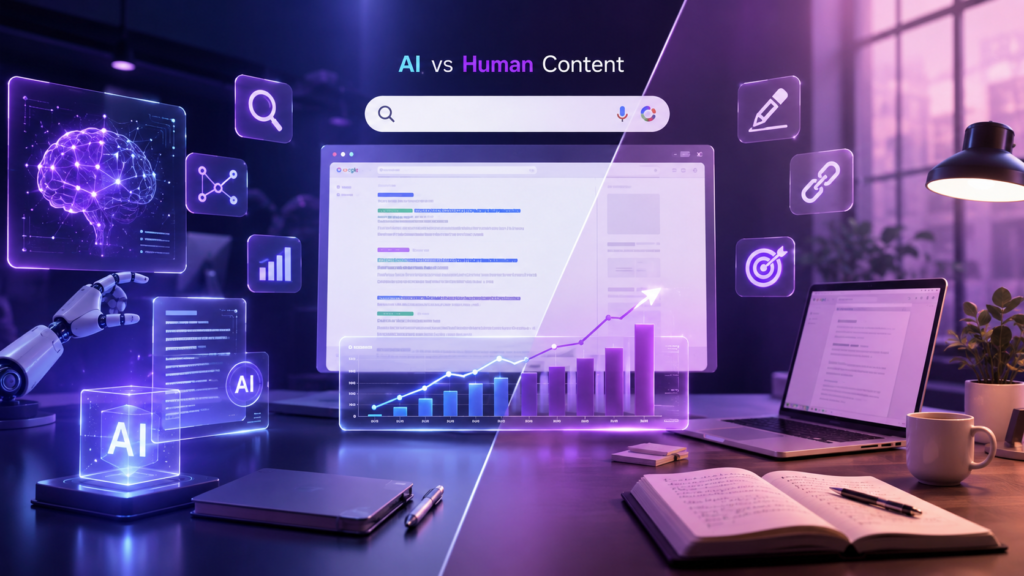
Marketers keep asking the same question whenever a new writing tool appears: does AI vs human content decide who ranks first on Google? The honest answer is that Google Search does not rank pages based on who typed them. It ranks pages based on quality, search intent, and trustworthiness. Still, the debate matters, because AI-generated content and human-written content behave differently in originality, depth, and accuracy. This article explains how each performs and how combining both builds stronger topical authority.
What Is AI Content?
AI content is text created using generative AI tools, large language models, and natural language processing systems. These tools generate sentences by predicting patterns from training data rather than lived experience. AI content works well for research summaries, outlines, and first drafts, but often lacks original insight until a human editor shapes it further.
- Produced through prompt engineering and machine learning models
- Generated quickly at scale for blogs and FAQs
- Strong at organizing information and structure
- Weak at original research and firsthand expertise
- Requires human fact verification before publishing
What Is Human Content?
Human content comes from writers who apply real expertise and editorial review to every sentence. A human writer adds original research and nuanced analysis that reflects genuine understanding of a topic. This content aligns closely with E-E-A-T principles because it demonstrates experience and authoritativeness that algorithms cannot fabricate.
- Reflects direct expertise and subject knowledge
- Includes original analysis and reasoned opinions
- Passes editorial review before publishing
- Aligns naturally with trustworthiness signals
- Adapts tone and depth to match search intent
How Google Evaluates Content Quality
Google Search Quality relies on the Search Quality Evaluator Guidelines and the Helpful Content System to judge whether a page satisfies a searcher’s need. These systems do not detect authorship directly. They measure accuracy, depth, structure, and user experience instead. Content that solves a problem clearly tends to rank well, regardless of the method used to produce it.
- Evaluates expertise, authoritativeness, and trustworthiness
- Measures how well a page matches search intent
- Rewards content freshness and factual accuracy
- Considers user experience and page structure
- Penalizes thin or unhelpful pages
AI Content vs Human Content in Search Rankings

When comparing ai vs human writing for actual ranking performance, the pattern stays consistent. Pages that combine accurate information with real depth rank well, whether a person wrote every word or used AI during drafting. Pages relying only on unedited AI output tend to struggle, especially on competitive topics.
- Rankings depend on content quality, not authorship method
- Unedited AI text often underperforms on expert topics
- Human-reviewed AI drafts can perform as well as human content
- Search ranking rewards depth over word count
- SEO still requires structured, intent-focused writing
Strengths of AI Content
AI tools bring real advantages when used correctly inside a content strategy. They speed up research, help structure topic clusters, and support internal linking planning. Marketers who treat AI as an assistant rather than a replacement often see stronger results.
- Speeds up drafting and content ideation
- Helps organize topic clusters and outlines
- Assists with keyword research and optimization
- Supports scaling content across large sites
- Useful for summarizing complex information
Strengths of Human Content
Human writers bring context that machines cannot replicate. They understand audience needs and the reasoning behind why a fact matters, not just the fact itself. This depth is exactly what the Search Quality Evaluator Guidelines describe when discussing expertise and trustworthiness.
- Provides original research and firsthand reasoning
- Builds trust through verified claims
- Adjusts messaging for specific audiences
- Strengthens authoritativeness through editorial judgment
- Supports long-term topical authority
Common Mistakes That Reduce Rankings
Many websites lose ranking potential not because they use AI, but because they skip the editorial steps that make content genuinely helpful. Publishing unverified claims or ignoring search intent weakens performance regardless of who or what wrote the page.
- Publishing AI drafts without fact verification
- Ignoring search intent during content planning
- Duplicating ideas across similar pages
- Skipping structured data and internal linking
- Failing to update content after core updates
Best Practices for Combining AI and Human Expertise
The strongest content strategy treats ai vs human writing as a partnership, not a competition. AI handles research speed and structure, while human editors add expertise and shape the final voice, supporting both traditional rankings and newer systems like AI Overviews.
- Use AI for outlines, research, and first drafts
- Apply human editorial review before publishing
- Verify every fact and statistic independently
- Add original examples and expert commentary
- Structure content for featured snippets
Future of AI and Human Content in Search
Generative Engine Optimization and Answer Engine Optimization are reshaping how content gets discovered. AI Overviews and zero-click search pull from pages that answer questions clearly and completely. As these systems mature, sites that succeed will treat AI as a tool for efficiency while keeping human expertise central.
- AI search engines favor clear, complete answers
- Structured data helps machines understand entities
- Zero-click search raises the value of concise answers
- Human oversight remains central to trustworthiness
- Content strategy must plan for AI-driven search
What, Why, When, and How
What matters most in the AI vs. human content debate is not who writes better sentences, but who produces content that genuinely helps a reader. This is why every digital marketing agency should focus on creating content that delivers real value instead of simply publishing more.
Why does this matter now? Generative AI has made content production faster, so quality control has become the real differentiator between pages that rank and pages that get ignored. AI is excellent for research, outlining, and drafting, but human expertise remains essential for accuracy, originality, and trust.
When should a team lean on AI, and when should human expertise take over? AI suits early research and drafting, while human review becomes essential before anything goes live, especially for health, finance, or safety topics. The most effective approach is to use AI to accelerate research and structure, then have a subject matter expert verify facts, refine the tone, and ensure the content truly meets the reader’s needs.
Conclusion
The real question was never whether AI vs human content wins outright, since Google does not reward one method by default. It rewards pages that show expertise, accuracy, and genuine usefulness. AI tools accelerate research and structure, but human judgment remains necessary for verification and original insight. Sites that combine both, using AI for speed and humans for quality control, are best positioned to perform well across search rankings and AI-powered search experiences.
FAQ
Does Google penalize AI-generated content automatically? No. Google evaluates helpfulness and search intent, not authorship method.
Can AI content rank as well as human content? Yes, when it passes human fact verification and editorial review first.
What does E-E-A-T mean in the ai vs human context? It stands for experience, expertise, authoritativeness, and trustworthiness. Human involvement strengthens all four, especially firsthand experience.
How does the Helpful Content System treat mixed content? It judges the end result, not the process. AI efficiency paired with human accuracy often outperforms either method alone.
Is human writing still necessary for SEO? Yes. Human writers add original research and editorial oversight that algorithms cannot replicate.
How can businesses combine AI vs human strengths effectively? Use AI for research and drafting speed, then let human experts verify facts and refine tone.
Will AI Overviews change how ai vs human content gets evaluated? AI Overviews favor complete, trustworthy answers, which raises the value of human-verified accuracy.